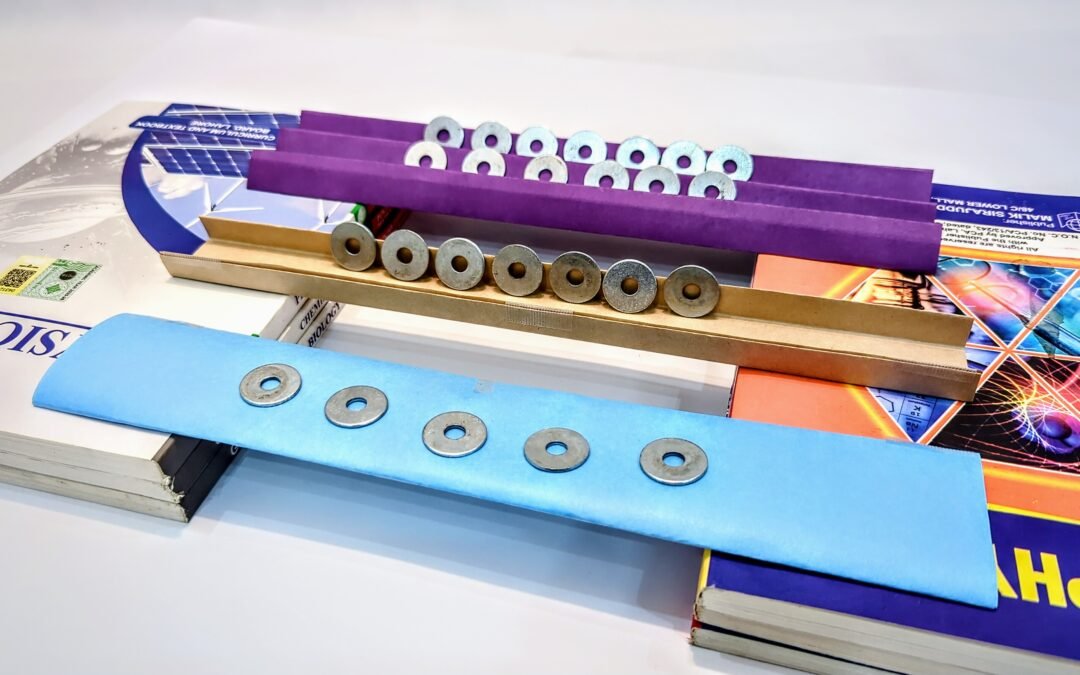
Build and test different paper bridge designs to discover how shape affects strength. In this hands-on STEM activity, a flat paper sheet, folded slab, and channel-shaped bridge are compared using metal washers as weights. This project introduces structural engineering, load distribution, and bridge design in a simple and exciting way.
Difficulty Level: Easy
Concepts: Engineering, Structural Engineering, Bridge Design
Materials List
- A4 paper sheets
- Small metal washers or coins
- Two stacks of books or support blocks
- Ruler or measuring tape
- Tape
- Notebook for recording results
- Optional colored paper for visibility
Steps
- Create the testing gap
- Place two books or supports apart to create a bridge gap.
- Start with a:
6 inch gap - Later increase it to:
10 inch gap
- Test a flat paper sheet
- Place a flat A4 paper sheet across the gap.
- Carefully add washers in the center one by one.
- Observe:
How quickly the paper bends or collapses. - Record the maximum weight held.
- Create the folded slab bridge
- Take another A4 sheet.
- Fold it twice along the length to create a thicker slab shape.
- Place it across the supports and repeat the weight test.
- Compare the strength with the flat sheet.
- Build the channel bridge
- Take another A4 sheet and fold both edges upward to create a channel shape.
- This creates side walls that help support weight.
- Place it across the gap and add washers carefully.
- Record how much weight it can hold.
- Compare the results
- Your channel bridge was able to hold:
- 167 grams at a 6 inch gap
68 grams at a 10 inch gap - Compare all three bridge designs and observe which structure is strongest.
Science Behind It
This experiment demonstrates how shape and structure affect strength.
Even though all bridges used the same paper material:
Their strength changed dramatically depending on the shape.
Flat Sheet vs Structured Shape
A flat paper sheet bends easily because it has very little resistance to downward force.
When paper is folded:
- Its stiffness increases
- Its shape distributes force more efficiently
This makes the structure stronger.
Why the Channel Shape Was Stronger
The channel bridge had raised sides.
These side walls helped:
- Reduce bending
- Spread the load across the structure
- Support the center section
This is similar to real engineering designs used in:
- Bridges
- Steel beams
- Buildings
- Aircraft structures
Load Distribution
When weight is added to a bridge:
- Forces travel through the structure.
Good bridge designs spread the force evenly instead of concentrating it in one weak area.
That is why shaped materials are often much stronger than flat materials.
Why the Longer Gap Held Less Weight
At the 10 inch gap:
- The bridge span increased
- More bending force acted on the center
This reduced the load capacity from:
- 167 grams → 68 grams
This demonstrates how bridge length affects structural strength.
Experiment Ideas 🧪
- Try different bridge shapes
- Test multiple layers of paper
- Compare paper vs cardboard bridges
- Measure bridge bending before collapse
- Try wider or narrower channel folds
- Test different bridge spans
Safety Notes
- Do not overload the bridge suddenly.
- Place weights gently to avoid snapping or falling objects.
- Keep small washers away from very young children.
Watch the video!
Keywords: paper bridge experiment, paper bridge STEM project, bridge strength experiment, engineering for kids, folded paper strength, DIY paper bridge, bridge load test, structural engineering activity, STEM bridge project, channel beam experiment, paper engineering model, simple physics experiment, civil engineering for kids, load bearing structure experiment, strong paper bridge project, STEM bridge activity, structural engineering for kids, load bearing bridge experiment, bridge design science project, paper folding strength experiment, engineering STEM activity, paper structure experiment