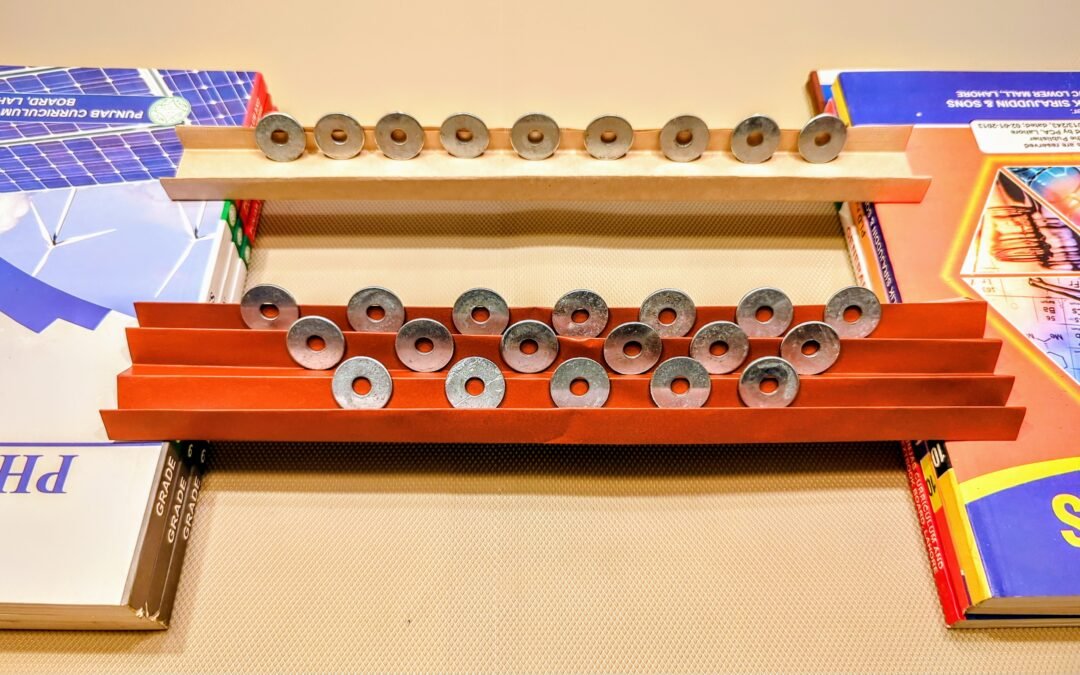
Discover how folding paper into an accordion structure can dramatically increase its load-bearing strength. In this STEM bridge experiment, an accordion-shaped paper bridge spanning 10 inches successfully supported 215 grams of evenly distributed metal washers. This project demonstrates structural engineering, force distribution, and why folded designs are used in real-world construction.
Difficulty Level: Easy
Concepts: Engineering, Structural Engineering, Bridge Design
Materials List
- A4 paper sheet
- Metal washers or coins
- Two support stacks or books
- Tape
- Ruler or measuring tape
- Notebook for recording results
Steps
- Prepare the bridge supports
- Place two stacks of books or supports:
- 10 inches apart
- This will create the bridge span.
- Create the accordion folds
- Take an A4 paper sheet and fold it back and forth repeatedly like an accordion or fan.
- Try to keep the folds evenly spaced.
- This folded structure creates many support ridges.
- Position the bridge
- Place the accordion-fold bridge across the 10 inch gap.
- Make sure it sits evenly on both supports.
- Add the weights
- Carefully place metal washers across the bridge.
- Spread the washers evenly across the entire suspended length instead of placing them in one spot.
- Observe how the structure responds.
- Record the results
- The accordion bridge successfully supported:
- 215 grams across a 10 inch span
- Compare this with the earlier flat sheet and channel bridge experiments.
Science Behind It
This experiment demonstrates how folded structures can become much stronger than flat materials.
Even though the bridge was made from a single sheet of paper:
Its shape dramatically increased its strength.
Why Accordion Shapes Are Strong
The accordion folds created multiple ridges and valleys.
These folds helped:
- Increase stiffness
- Reduce bending
- Distribute force more evenly
- Support weight across the entire bridge
Instead of one flat weak surface:
- The paper became a structured framework.
Load Distribution
The washers were spread evenly across the bridge.
This prevented too much force from concentrating at one point.
Even load distribution helps structures carry heavier weights safely.
This is similar to how:
- Real bridges
- Roof panels
- Cardboard structures
- Steel beams
are designed in engineering.
Why Folded Shapes Matter in Engineering
Engineers often strengthen materials by changing their shape instead of increasing material thickness.
Examples include:
- Corrugated cardboard
- Metal roofing sheets
- Bridge trusses
- Shipping containers
The folds increase strength while keeping the structure lightweight.
Experiment Ideas 🧪
- Try different fold sizes
- Test narrow vs wide accordion folds
- Compare accordion vs channel bridge strength
- Test different bridge spans
- Add weight in the center only vs evenly spread
- Use cardboard instead of paper
Safety Notes
- Add weights slowly and carefully.
- Avoid placing heavy objects suddenly on the bridge.
- Keep small washers away from very young children.
Watch the video!
Keywords: accordion paper bridge, paper bridge experiment, STEM engineering project, strong paper bridge, structural engineering for kids, load bearing bridge experiment, folded paper strength, DIY paper bridge, engineering science activity, bridge design experiment