Take paper bridge engineering to the next level by combining accordion and channel bridge designs into advanced hybrid structures. In this experiment, one combined bridge supported 293 grams, while a reinforced sandwich-style bridge held an impressive 826 grams across a 10 inch span. This STEM activity demonstrates structural reinforcement, force distribution, and real-world engineering concepts used in modern construction.
Difficulty Level: Easy
Concepts: Engineering, Structural Engineering, Bridge Design
Materials List
- A4 paper sheets
- Metal washers
- Tape
- Two support stacks or books
- Ruler or measuring tape
- Notebook for recording results
Steps
- Create the accordion insert
- Fold an A4 paper sheet back and forth into an accordion shape.
- Create the outer channel
- Take another A4 sheet and fold both long sides upward to form a channel bridge.
- Combine the structures
- Insert the accordion fold inside the channel bridge.
- The accordion acts like internal reinforcement.
- Test the bridge
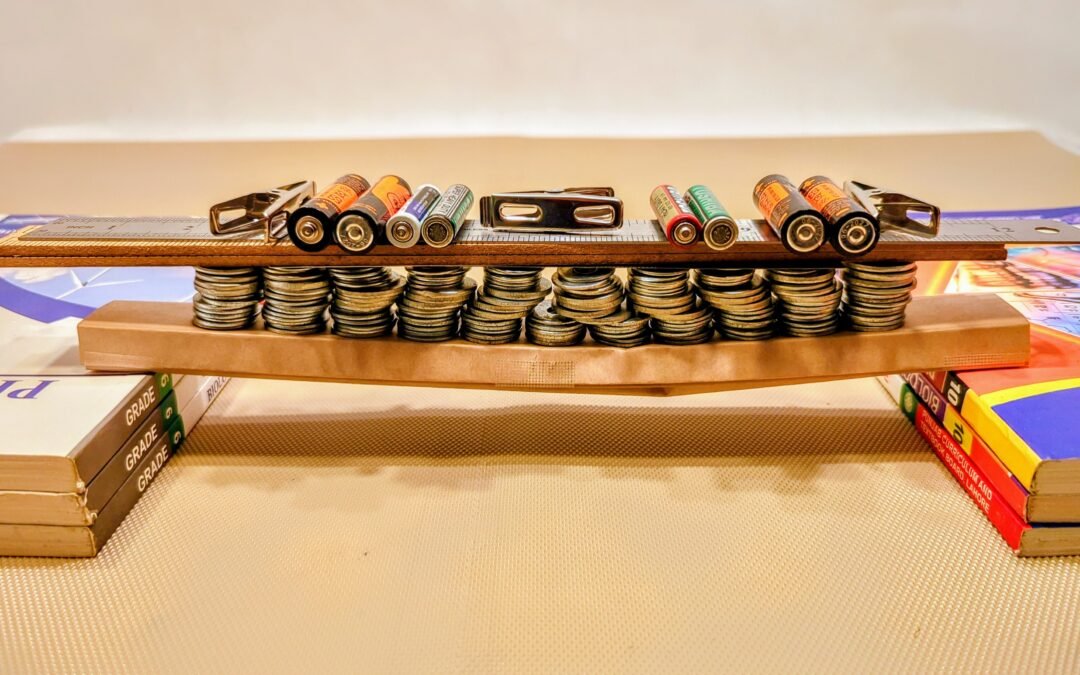
- Place the bridge across a:
- 10 inch gap
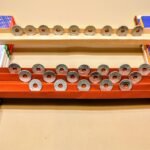
- Carefully add washers evenly across the bridge span.
- The combined bridge successfully supported:
- 293 grams
- Place the bridge across a:
- Part 2 – Sandwich Reinforced Bridge
Build the accordion core- Create another accordion-fold insert.
- Add dual channel supports
- Instead of using one channel bridge:
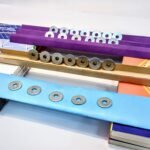
- Sandwich the accordion structure between two channel bridges.
- This creates a boxed reinforcement structure.
- Instead of using one channel bridge:
- Test the reinforced bridge
- Place the reinforced bridge across the same:
- 10 inch gap
- Carefully distribute the washers evenly.
- The reinforced bridge successfully held:
- 826 grams
- Place the reinforced bridge across the same:
Science Behind It
This experiment demonstrates how engineers increase structural strength by combining multiple support systems together.
Even though the bridges were still made mostly from paper:
Their strength increased dramatically through smart design.
Why the Combined Bridge Was Stronger
The accordion structure acted like internal ribs or reinforcement beams.
The outer channel structure helped:
- Reduce bending
- Hold the shape steady
- Distribute forces more evenly
Together, the structures supported far more weight than either design alone.
Why the Sandwich Design Became Extremely Strong
In the second design:
The accordion core was trapped between two channel structures.
This created a lightweight box beam.
Box-shaped structures are extremely strong because they resist:
- Bending
- Twisting
- Compression
This is similar to structures used in:
- Aircraft wings
- Steel bridge beams
- Building supports
- Cardboard packaging
- Train frames
Load Distribution and Structural Reinforcement
The washers were spread evenly across the bridge.
This reduced stress concentration in one area.
By combining multiple folded shapes:
- The paper became a reinforced structural system instead of a simple sheet.
Real Engineering Connection
This experiment demonstrates a major engineering principle:
- Shape can be more important than material thickness.
Smart structural design can dramatically increase strength while keeping materials lightweight.
That is exactly how many real-world structures are engineered.
Experiment Ideas 🧪
- Try different accordion fold counts
- Test wider channel bridges
- Compare single vs double channel reinforcement
- Measure bridge bending before failure
- Try different bridge spans
- Use cardboard instead of paper
Safety Notes
- Place weights gently and evenly.
- Avoid dropping washers suddenly onto the bridge.
- Keep small metal pieces away from young children.
Watch the video!
Keywords: strong paper bridge experiment, paper bridge STEM project, accordion bridge engineering, channel bridge experiment, structural engineering for kids, load bearing paper bridge, reinforced paper bridge, DIY engineering project, paper bridge science experiment, advanced paper bridge design, super strong paper bridge