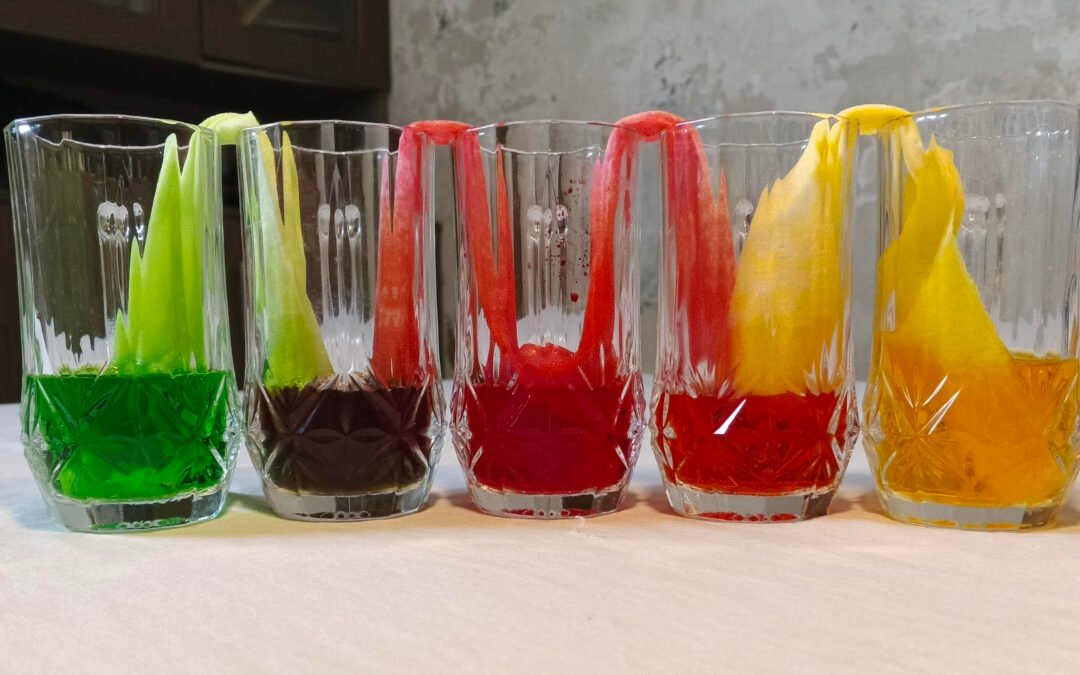
This classic walking water experiment uses colored water and tissue paper to show how water “climbs” upward — the same process plants use to move water from their roots to their leaves. Simple, visual, and perfect for kids.
Difficulty Level: Easy
Concepts: Capillary Action, Plant Biology, Water Transport, Gravity
Materials List
- 3–6 transparent glasses or cups
- Tissue paper / paper towel strips
- Water
- Food coloring (red, blue, yellow, etc.)
- Scissors
Steps
- Prepare the Cups: Arrange the cups in a row or circle. Fill every other cup with colored water; leave the rest empty.
- Make Paper Bridges: Cut paper towel into long strips and fold them into thick bands.
- Set Up the Path: Place one end of each paper strip into a cup with colored water and the other end into an empty cup.
- Wait & Watch: Over the next few minutes to hours, the water begins to climb up the paper strip.
- Observe Color Mixing: Where two colors meet (like blue + yellow), new colors form in the empty cups.
- Explain Capillary Action: Highlight how water moves upward even against gravity.
- Record Results: Take photos or notes on how long it takes each color to “walk.”
Science Behind It
The experiment demonstrates capillary action, a process where water molecules cling to surfaces (adhesion) and pull each other along (cohesion). Plants use this exact method to transport water from their roots to their stems and leaves, allowing them to survive and grow.
Watch the video!
Keywords: walking water experiment, capillary action for kids, plant water transport, easy science experiment, color mixing activity, STEM for children, how plants drink water, cohesion adhesion experiment, home science project, paper towel water experiment, How Plants Suck Water from ground, DIY Walking Water STEM Activity