
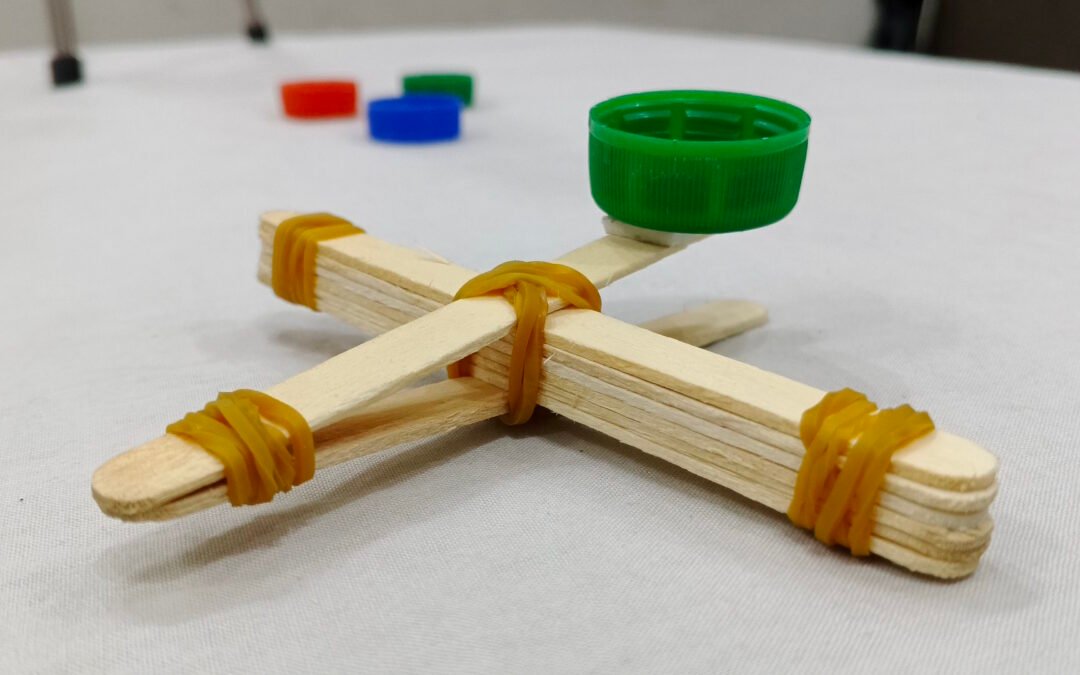
Build a mini catapult using popsicle sticks, rubber bands, and a bottle cap. This fun and easy STEM activity teaches the basics of tension, force, and projectile motion - perfect for classrooms and home learning activities.
Difficulty Level: Easy
Key Concepts: Physics, engineering, kinetic energy, potential energy, projectile motion
Materials List
- 7–9 popsicle sticks
- Rubber bands
- Plastic bottle cap
- Double-sided Tape or Glue
- Pom-pom / paper ball for launching
Steps
- Prepare the Base: Stack 5–7 popsicle sticks together and wrap rubber bands on both ends.
- Make the Arm: Take 2 sticks, band them at one end, and leave the other end open.
- Combine: Slide the stack between the 2 stick “arm” pieces, forming a lever.
- Add Launch Cup: Glue a bottle cap at the free end of the top stick.
- Adjust Angles: Move the lever arm up or down to increase or decrease tension.
- Load & Launch: Place a pom-pom in the cap, press down, and release to fire.
- Experiment: Change the rubber bands, angle, or number of sticks to test performance.
Science Behind It
The catapult works by storing elastic potential energy in the rubber bands. When released, that stored energy converts into kinetic energy, launching the projectile forward. Kids learn how tension, angles, mass, and force affect projectile motion - the same physics behind real catapults and slingshots.
Watch the video!
Keywords: popsicle stick catapult, DIY catapult, kids STEM project, easy physics activity, tension and force experiment, projectile motion for kids, simple engineering project, rubber band catapult, science fair ideas, hands-on learning