
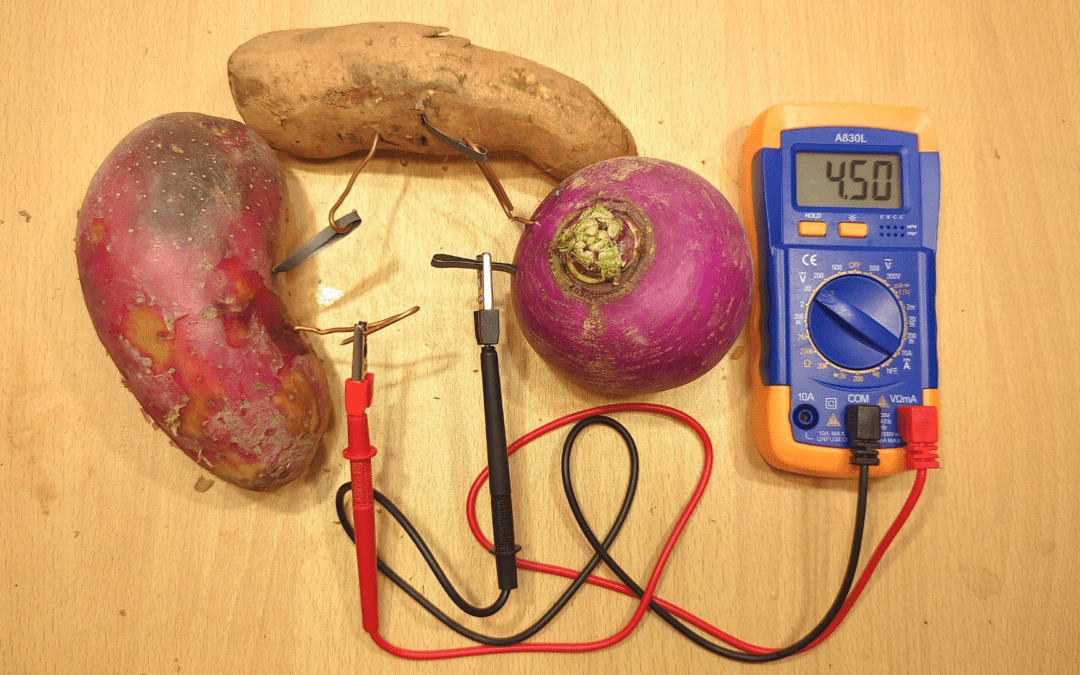
Discover how vegetables can generate electricity using simple metal electrodes. In this fun STEM experiment, potatoes, sweet potatoes, and turnips are connected to create a vegetable battery powerful enough to light up an LED.
Difficulty Level: Easy
Concepts: Electrochemistry, Electronics, Energy Storage, Energy Conversion
Materials List
- Potato
- Sweet potato
- Turnip
- Copper wire or copper electrode
- Zinc-coated nail or galvanized screw
- Electrical wires with clips
- Multimeter
- 5mm red LED
- Tape (optional)
Steps
- Prepare the vegetables
- Wash the potato, sweet potato, and turnip.
- Insert metal electrodes
- Place one copper electrode and one zinc-coated nail into each vegetable.
- Measure individual voltage
- Use a multimeter to test the voltage from each vegetable battery.
- Connect the vegetables in series
- Join the copper of one vegetable to the zinc of the next.
- Measure total voltage
- Test the combined voltage after connecting all vegetables together.
- Connect the LED
- Attach the LED to the positive and negative ends of the vegetable battery chain.
- Observe the result
- Watch the LED glow using electricity generated from vegetables. ⚡
Science Behind It
This project demonstrates how a simple electrochemical battery works.
Chemical Energy to Electrical Energy ⚡
Vegetables contain water, acids, and dissolved salts that help electricity flow.
When two different metals are inserted:
- A chemical reaction occurs
- Electrons begin to move
- Electricity is produced
Why Two Metals Are Needed 🔩
The experiment uses:
- Copper electrode
- Zinc-coated nail
Different metals react differently, creating a voltage difference.
This voltage pushes electrons through the circuit.
Series Connection Increases Voltage 🔗
Each vegetable produces a small voltage.
When connected in series:
- The voltages add together
- Total voltage increases
This made it possible to light the LED.
LED Lighting 💡
The LED glows when enough electrical energy flows through it.
This demonstrates:
- Circuits
- Voltage
- Conductivity
- Electrochemistry
Experiment Ideas 🧪
- Compare different vegetables and fruits
- Test lemon vs potato batteries
- Add more vegetables in series
- Measure voltage changes over time
- Try lighting different colored LEDs
Watch the video!
Keywords: potato battery experiment, vegetable battery project, electrochemistry STEM activity, DIY electricity experiment, potato LED project, science fair battery experiment, fruit and vegetable battery, simple chemistry experiment, homemade battery project, electricity from vegetables