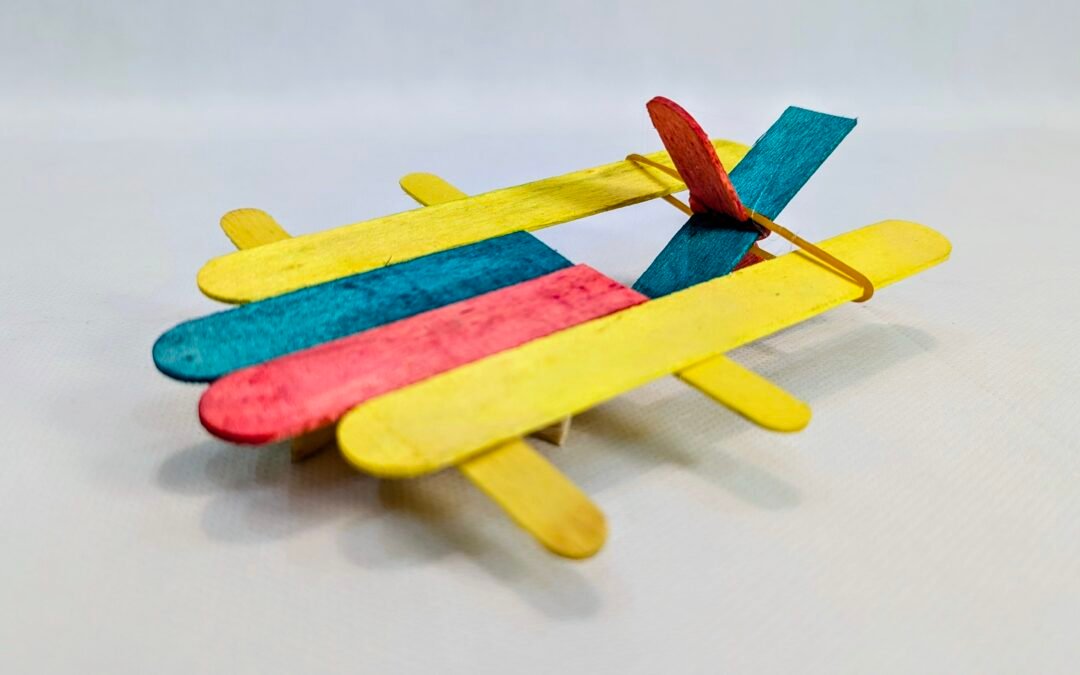
Build a rubber band powered paddle boat using craft sticks and explore how multi-blade paddles improve movement in water. This fun STEM project introduces propulsion, design, and energy transfer through a simple hands-on activity.
Difficulty Level: Easy to Medium
Concepts: Potential Energy, Thrust, Newton’s Third Law of Motion
Materials List
- Large craft sticks (ice cream sticks)
- Rubber band
- Small stick or skewer (axle support)
- Glue (or tight friction fit if avoiding glue)
- Cutter/scissors (with supervision)
Steps
- Build the boat base
- Arrange and glue craft sticks side by side to form a flat base.
- Create supports
- Add raised sticks at the back to hold the paddle axle.
- Make the paddle blades
- Take two sticks and cut a small notch in the center of each.
- Create 4-blade paddle
- Fit the two notched sticks together in a “+” shape.
- Attach rubber band
- Loop a rubber band through the center of the paddle.
- Mount the paddle
- Fix the paddle at the back of the boat using a support stick.
- Wind it up
- Twist the paddle to store energy in the rubber band.
- Release in water
- Place it in water and watch it move forward 🚤
Science Behind It
This project demonstrates elastic energy and propulsion.
This project demonstrates propulsion and design efficiency.
Elastic Energy 🔋
Twisting the rubber band stores elastic potential energy.
Energy to Motion 🔄
When released:
- The rubber band untwists
- The paddle spins
4-Blade Advantage
Compared to 2 blades:
- More surface area → pushes more water
- Smoother motion → less wobble
- Better efficiency → more consistent speed
Why It Moves ⚙️
The paddle pushes water backward.
👉 The boat moves forward due to action and reaction.
Experiment Ideas 🧪
- Compare 2-blade vs 4-blade paddle
- Change paddle size
- Try different rubber band strengths
- Test in still vs moving water
- Measure distance traveled
Watch the video!
Keywords: rubber band paddle boat, DIY boat for kids, 4 blade paddle experiment, STEM water project, propulsion experiment, kids engineering activity, elastic energy project, simple boat model, science project for kids