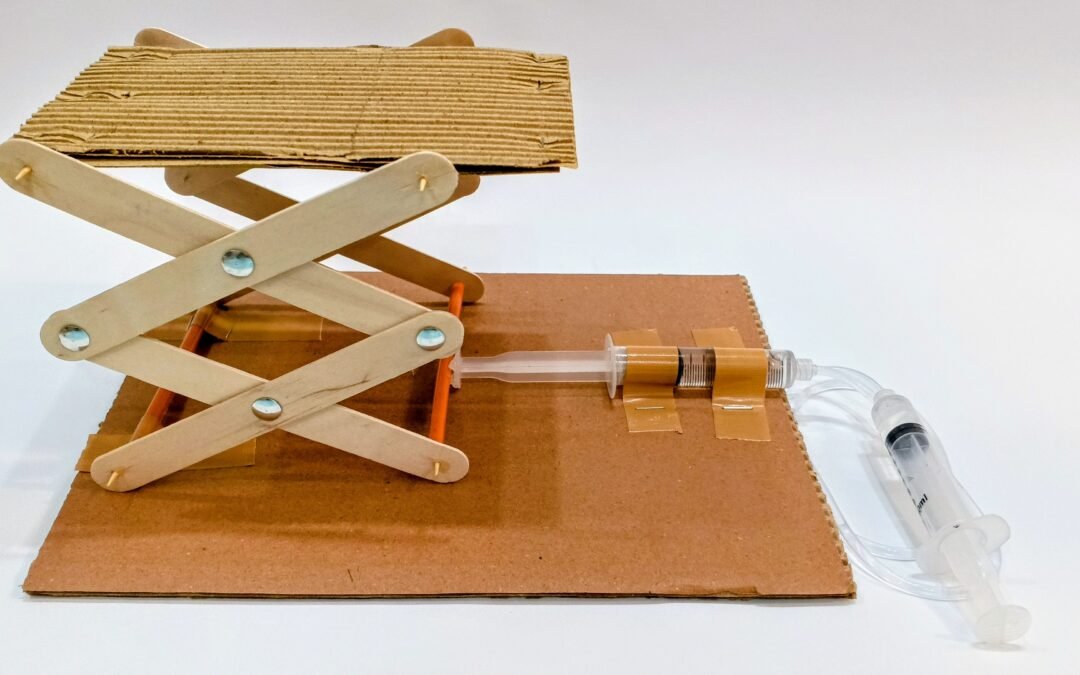
Build a working hydraulic lift using syringes, tubes, and sticks to explore how liquids transfer force. This hands-on STEM project demonstrates Pascal’s Law and shows how machines like car lifts and excavators work in real life.
Difficulty Level: Medium
Concepts: Hydraulics, Energy Transfer, Pascal's Law
Materials List
- Cardboard base
- Tongue Depressors OR Large Ice cream sticks (for scissor mechanism)
- Paper fasteners or small nuts/bolts (for joints)
- 2 syringes (without needles)
- Plastic tube / drip set pipe
- Water (can add food color for fun)
- Glue (hot glue recommended with supervision)
- Stapler
- Tape
Steps
- Build the base
- Cut a strong cardboard base to hold your lift.
- Make the scissor structure
- Use ice cream sticks to create an “X” pattern and join them in the center using fasteners.
- Stack the scissor layers
- Connect multiple “X” shapes to form a lifting structure like a scissor lift.
- Add the top platform
- Attach a cardboard piece on top where objects will be lifted.
- Attach the syringe system
- Connect two syringes using a plastic tube. Fill them with water (no air bubbles!).
- Fix one syringe to the base
- Attach one syringe horizontally to the base and connect its plunger to the lift.
- Test your lift
- Push the syringe — the platform will rise! Pull it back — it goes down ⬆️⬇️
Science Behind It
This project demonstrates Pascal’s Law.
What is Pascal’s Law?
It states:
“Pressure applied to a liquid is transmitted equally in all directions.”
How it works
When you push one syringe:
- You apply pressure to the water
- The water transfers that pressure through the tube
- The second syringe moves, lifting the structure
Real-Life Examples
This is how many machines work:
- Car hydraulic lifts 🚗
- Excavators 🚜
- Brakes in vehicles 🛑
Liquids are powerful because they don’t compress easily, making them perfect for transferring force!
Watch the video!
Keywords: hydraulic lift model, Pascal’s law experiment, syringe hydraulic system, STEM engineering project, physics for kids, DIY hydraulic lift, pressure in liquids experiment, simple machines project, kids science activity