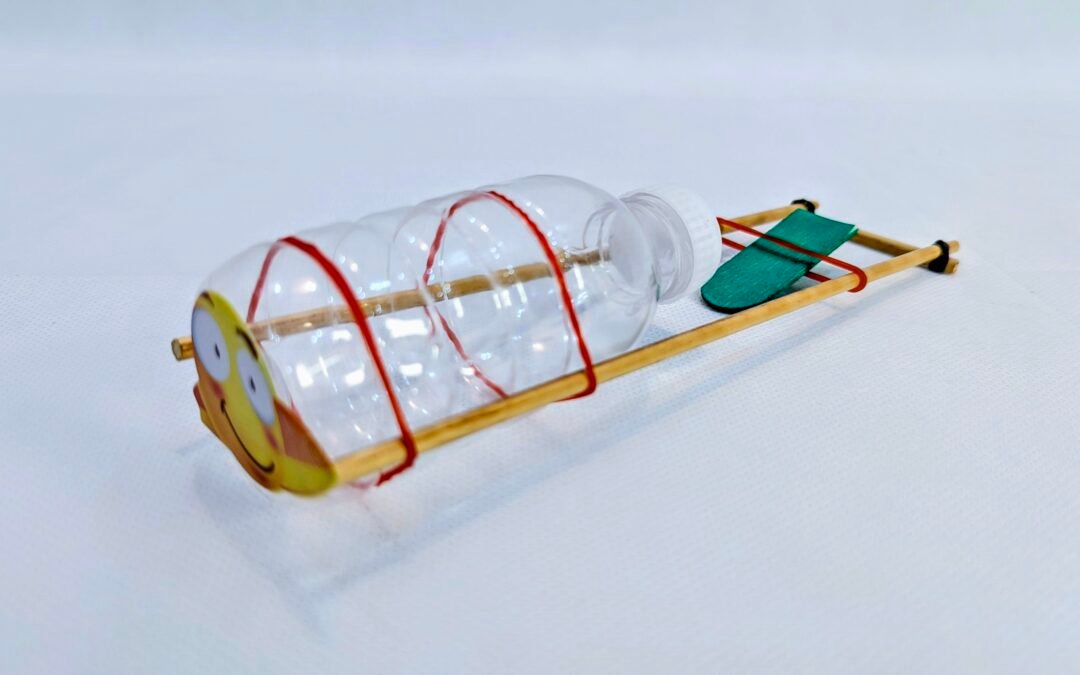
Build a rubber band powered boat using a plastic bottle and simple sticks - no glue or tape needed! This fun STEM project shows how stored energy can be used to create motion on water.
Difficulty Level: Easy
Concepts: Potential Energy, Thrust, Newton’s Third Law of Motion
Materials List
- Plastic bottle (small)
- Soft cane sticks / wooden skewers
- Rubber bands
- Small piece of foam or cardboard (for paddle)
- Thread or thin elastic (optional for binding)
Steps
- Build the frame
- Use sticks to create a rectangular frame around the bottle.
- Secure the bottle
- Hold the bottle in place using rubber bands (no glue needed!).
- Create the paddle
- Cut a small rectangular piece of foam or cardboard.
- Attach the paddle
- Fix the paddle between two rubber bands so it can rotate.
- Add tension system
- Stretch a rubber band from the front of the frame to the paddle.
- Wind it up
- Twist the paddle to wind the rubber band and store energy.
- Release in water
- Place the boat in water and let go - watch it move forward! 🚤
Science Behind It
This project demonstrates elastic energy and propulsion.
Stored Energy 🔋
When you twist the rubber band, you store elastic potential energy.
Energy Conversion 🔄
When released:
- The rubber band untwists
- The paddle spins
Water Propulsion 💧
The spinning paddle pushes water backward.
The boat moves forward due to action and reaction (Newton’s Third Law).
Balance & Design ⚖️
- A centered frame helps stability
- A wider base prevents tipping
- Paddle size affects speed
Experiment Ideas 🧪
- Try different paddle sizes
- Use thicker vs thinner rubber bands
- Test different bottle sizes
- Add weight and observe changes
- Race different designs!
Watch the video!
Keywords: rubber band boat, DIY boat for kids, STEM water experiment, elastic energy project, no glue science project, simple engineering project, kids STEM activity, propulsion experiment, boat experiment for kids