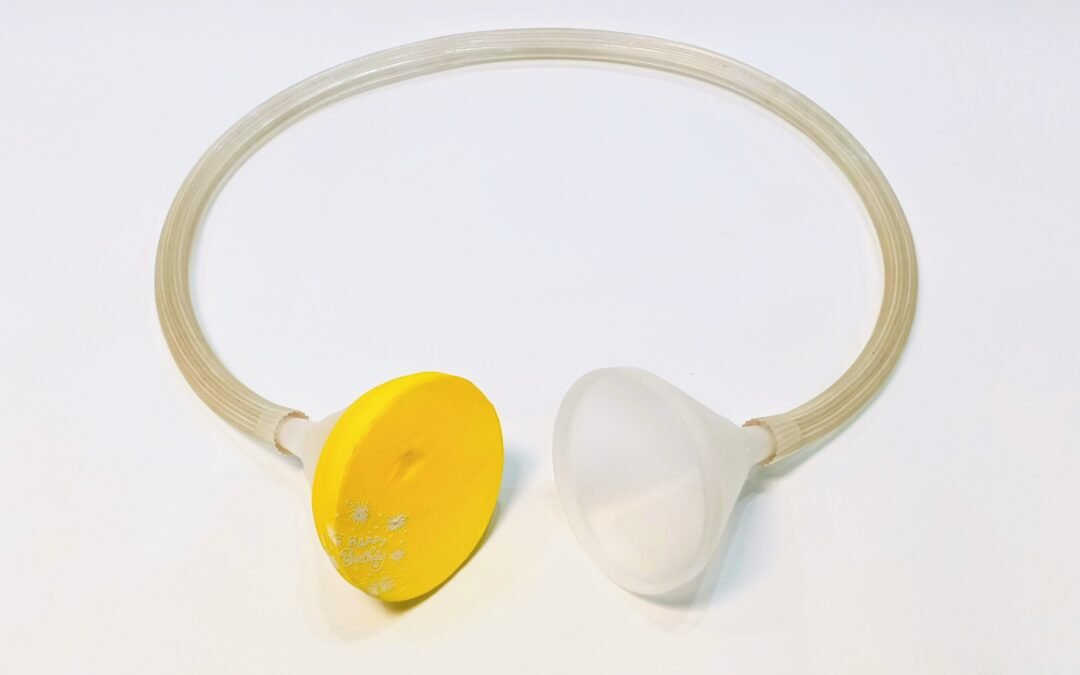
A kid-friendly DIY stethoscope model that teaches how doctors listen to heartbeat and breathing sounds using vibration and sound transmission through a tube.
Difficulty Level: Easy
Concepts: Stethoscopes, Health, Exercise, Heartbeat, Heart Rate, Breathing, Medical Engineering
Materials List
3 ft long ½ inch gas pipe (rubber or PVC)
Two small funnels (around 3 inch diameter)
One balloon
Scissors
Steps
- Prepare the Balloon: Cut off the balloon’s neck so it stretches easily.
- Make the “Chest Piece”: Wrap the stretched balloon tightly over the mouth of one funnel. This acts like a diaphragm (sound-catching membrane).
- Attach the Pipe: Push the narrow ends of both funnels into each side of the pipe - one with the balloon (chest piece), the other as the “ear piece.”
- Check the Seals: Make sure all connections are tight so the sound does not leak.
- Test Your Stethoscope:
- Place the balloon-covered funnel on the chest or wrist.
- Put your ear close to the other funnel.
- Listen to heartbeat or inhale/exhale sounds.
Science Behind It
A stethoscope works by capturing tiny vibrations from the body. When the heart beats or air moves in the lungs, it creates sound waves. The balloon diaphragm vibrates, the pipe carries these vibrations without much loss, and the funnel at the end amplifies them. This simple model demonstrates sound vibration, amplification, and transmission just like a real stethoscope.
Watch the video!
Keywords: diy stethoscope, stethoscope working model, heartbeat monitor experiment, breathing sound model, human biology project, sound vibration experiment, kids science project, stem stethoscope build, homemade stethoscope tutorial, sound transmission activity, easy science project for kids, biology stem activity, heartbeat listening experiment, how stethoscopes work, gardish pk projects