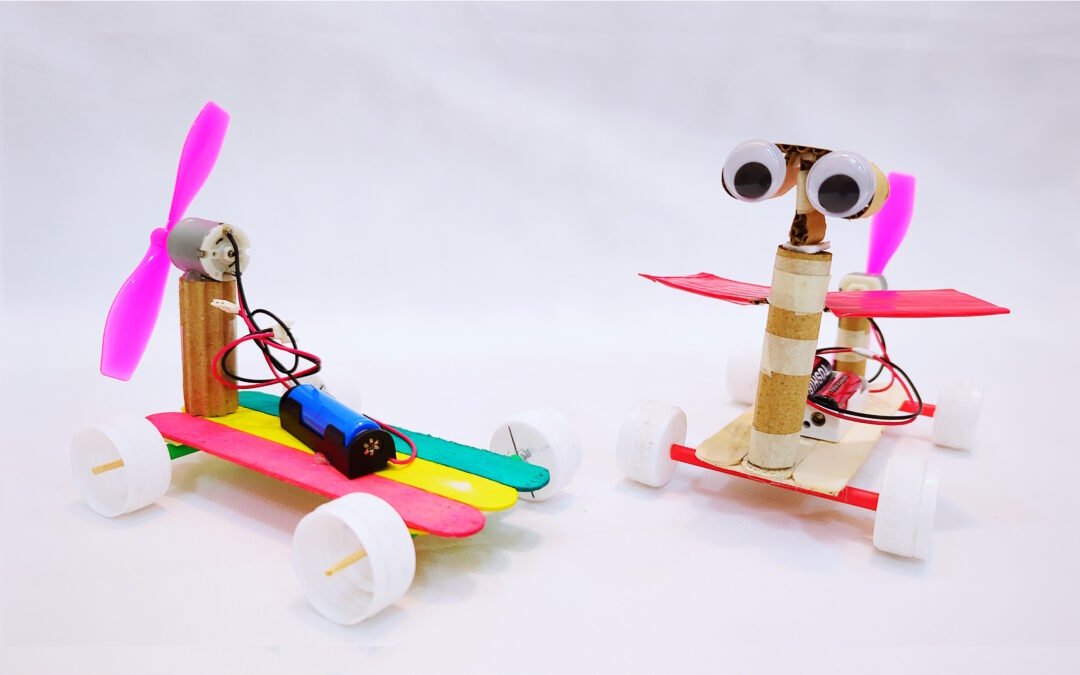
Build a propeller-powered car using DC motors and compare how different motors and batteries affect speed and performance. This fun STEM project helps kids understand thrust, energy, and how power sources impact motion.
Difficulty Level: Easy to Medium
Concepts: Electronics, Thrust, Laws of Motion
Materials List
- Cardboard or foam board (base)
- 4 bottle caps (wheels)
- Wooden skewers (axles)
- Straw pieces (axle holders)
- DC motor (N140/N130 type)
- Plastic propeller (toy fan)
- Battery (14500 lithium cell or 2× AA batteries)
- Battery holder
- Wires
- Switch (optional)
- Ice cream sticks (for structure)
- Glue (hot glue recommended)
- Tape
Steps
- Build the car base
- Cut a rectangular base and attach wheels using skewers and straws.
- Create motor mount
- Use cardboard or sticks to build a vertical stand for the motor.
- Attach the motor
- Fix the motor securely on the stand.
- Add the propeller
- Push the propeller onto the motor shaft.
- Connect the battery
- Wire the motor to your battery pack (add a switch if available).
- Power it up
- Turn it on - the propeller will spin and push air backward.
- Test and compare
- Try different motors and batteries to see which one is faster 🚗💨
Science Behind It
This project demonstrates thrust, energy, and power.
Thrust in Action 💨
The spinning propeller pushes air backward.
The car moves forward due to Newton’s Third Law.
Power Matters ⚡
Different motors and batteries produce different results:
- Stronger motor (N140) → More rotation speed
- Higher voltage (lithium battery) → More power output
More power = stronger thrust = faster car
Comparing Setups 🔋
| Setup | Result |
| N130 + AA batteries | Good speed, stable |
| N140 + 14500 lithium battery | Much faster, more powerful |
Real-World Connection
This is how:
- Drones fly 🚁
- Airplanes move ✈️
Experiment Ideas
- Try bigger vs smaller propellers
- Change battery voltage
- Adjust car weight
- Measure distance or speed
Watch the video!
Keywords: propeller car project, DC motor car for kids, thrust experiment STEM, motor speed experiment, DIY fan car, physics for kids, battery power comparison, STEM car project, kids robotics activity